
22% off the contract.
Before signature.
An $80M food manufacturer had three flawless vendor demos and a buying team that had never bought an ERP. The sellers do this every week. We ran the selection on the client's terms: their data, their ugliest scenarios, five-year cost instead of license price. The most polished demo lost.
$80M food manufacturer on QuickBooks and a warehouse bolt-on, with no lot tracking.
NetSuite, Microsoft D365, and a food-industry ERP. Every demo flawless, as demos always are.
Selection and contracting, client-side: requirements, structured evaluation, scored decision, SOW and license negotiation.
9 weeks, requirements to signed contract.
Vendor demos are built to hide exactly what matters.
The trigger was external: the client's largest retail customer announced lot-traceability requirements that QuickBooks and a bolt-on warehouse tool could not meet, with a date attached. Three vendors came to the table and every demo was flawless, because demos run on canned data.
Implementation quotes are built to win the deal, not to finish the project. Change-order rates sit in the contract's appendix precisely because they only matter later, which is when they matter most. And the buying team had never bought an ERP, while the sellers sell one every week. That asymmetry is where the next five years of cost gets decided.
The selection phase is the only moment the buyer holds the stronger hand. It never comes back after signature. So we spent it deliberately.
- Requirements first, with operations and quality. Lot tracking, catch weights, allergen segregation, recall simulation. The things that decide whether an ERP works for a food company, and the things demos skip.
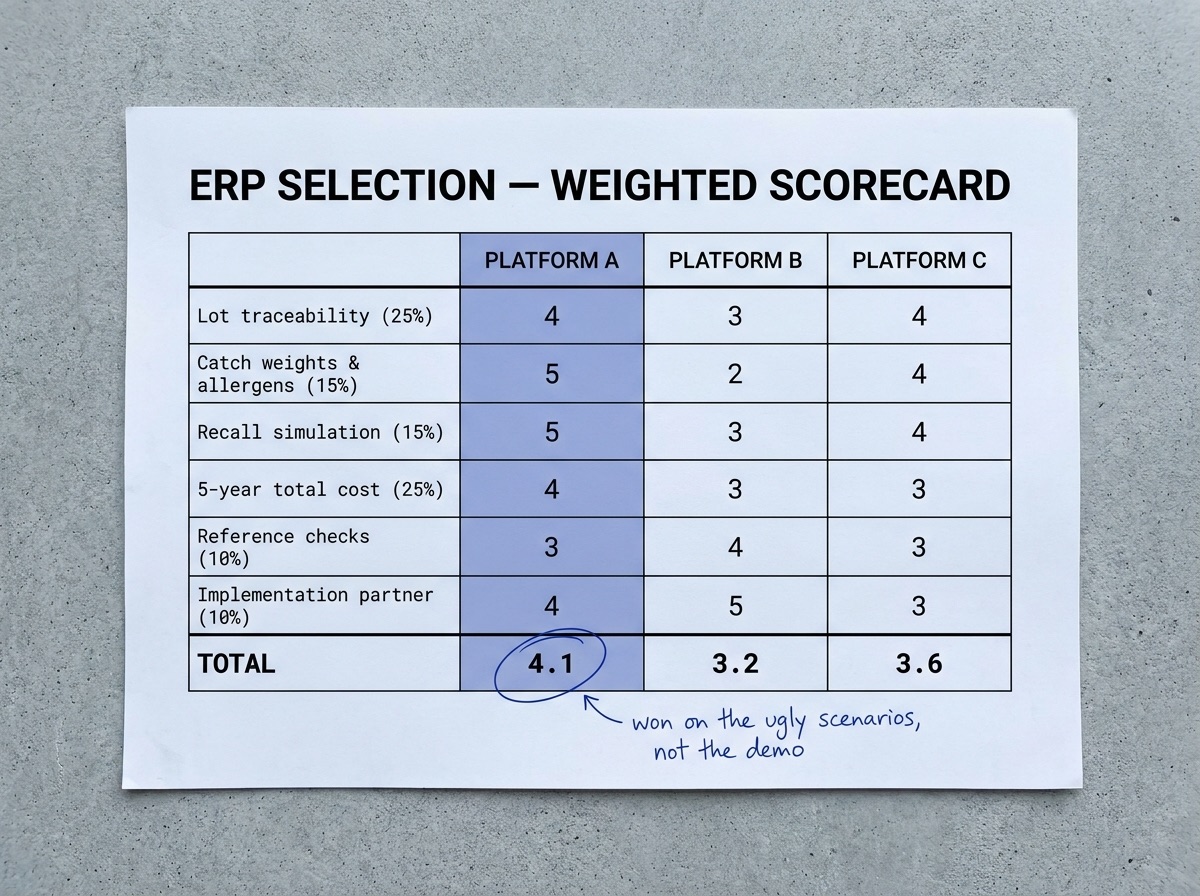
- Demos on the client's own data. Every finalist ran the client's five ugliest real scenarios, same script for every vendor. Two platforms handled them. One did not, and it was the one with the most polished demo.
- Scored the decision, weighted and in writing. Five-year total cost, not license price: implementation, integrations, support tiers, realistic change-order exposure.
- Reference checks that meant something. Two live customers per finalist, same size, same industry, asked about the second year, not the demo.
- Negotiated the winning contract. Quote down 22%. Hours-billed replaced by milestone payments. Change-order rates capped. Acceptance criteria written into each phase.
| Stage | What happened | Exit gate |
|---|---|---|
| Requirements, 2 wks | Operations and quality workshops; the recall-simulation test case written first | Requirements signed |
| Market screen | Long list to a shortlist of three against hard requirements | Shortlist agreed |
| Structured demos | Client data, five ugly scenarios, the same script for every vendor | Scored evaluations |
| Reference checks | Two live customers per finalist, same size, same industry | References documented |
| Decision | Weighted scorecard on five-year cost; recommendation to the board | Platform selected |
| Negotiation | SOW, license terms, change-order caps, milestone payments, acceptance criteria | Contract signed |
| Metric | Before | After | How measured |
|---|---|---|---|
| Implementation quote | $310K opening | $240K signed | Vendor proposals vs executed SOW |
| Payment structure | Time & materials | Milestone-based, with acceptance criteria | Contract terms |
| Change-order rates | “Then-current rates” | Capped in writing | Contract terms |
| Selection duration | — | 9 weeks, kickoff to signed contract | Engagement record |
| The implementation that followed | — | Hit its dates | Program plan vs actuals |
Anonymized case study. Client-identifying details redacted. Reference available on request.