
108 sites.
3 countries.
12 months.
A global F&B operator needed one POS across 108 hybrid restaurant-and-retail outlets in India, the UAE and the UK. Their own first attempt had stalled in pilot and cost a day of trading. We ran the second attempt from the client's side. Every outlet came up overnight and opened clean.
$1B+ global F&B operator. 108 hybrid outlets (restaurant + retail counter), company-owned and franchise.
Restroworks POS on an existing SAP S/4HANA backbone. Payments, aggregators, KDS, e-invoicing.
Implementation PMO, end to end: design & blueprint, SIT/UAT, phased rollout, hypercare.
12 months, pilot plus 4 waves, against an 18-month internal plan.
Every till was different. One had already failed.
The client had expanded internationally through acquisitions and its own store footprint, and the result was a patchwork of legacy tills. Every outlet runs a hybrid model: a restaurant and an integrated retail counter selling packaged food under the house brand. One POS has to handle dine-in, packaged goods and delivery orders, with each sale taxed correctly, because packaged snacks, dine-ins and deliveries can attract different tax treatment.
The estate: roughly 90 sites in India, 12 in the UAE, 6 in the UK. Company-owned and franchise. Several on patchy connectivity. Menu, SKU, recipe and pricing data lived in inconsistent shapes across the legacy systems, and cross-region reporting was hand-assembled and nine days late.
An earlier attempt to self-run the rollout had stalled in a single-market pilot. One botched cutover cost a full day of trading. With a loyalty and menu program depending on one clean operating spine, a second failed rollout across 100+ outlets was not an option.
- Prove once, repeat 108 times. A clean re-pilot on 3 company-owned Delhi-NCR outlets hardened the runbook and the hybrid config before any scale.
- Region-clustered waves. Dense metro clusters first, company-owned before franchise, India before international, festival peaks blacked out.
- Store-in-a-box. Till, KDS, payment terminal, weighing-scale integration and label printer pre-staged and pre-configured before shipping. On-site work was install and validate, not build.
- Overnight cutovers. Each outlet cut over after close and before open. Median window about 4 hours. No site lost a trading session.
- Offline-first go-lives. Every till validated to trade through a dropped line and sync on reconnect, because several sites could not assume a stable connection.
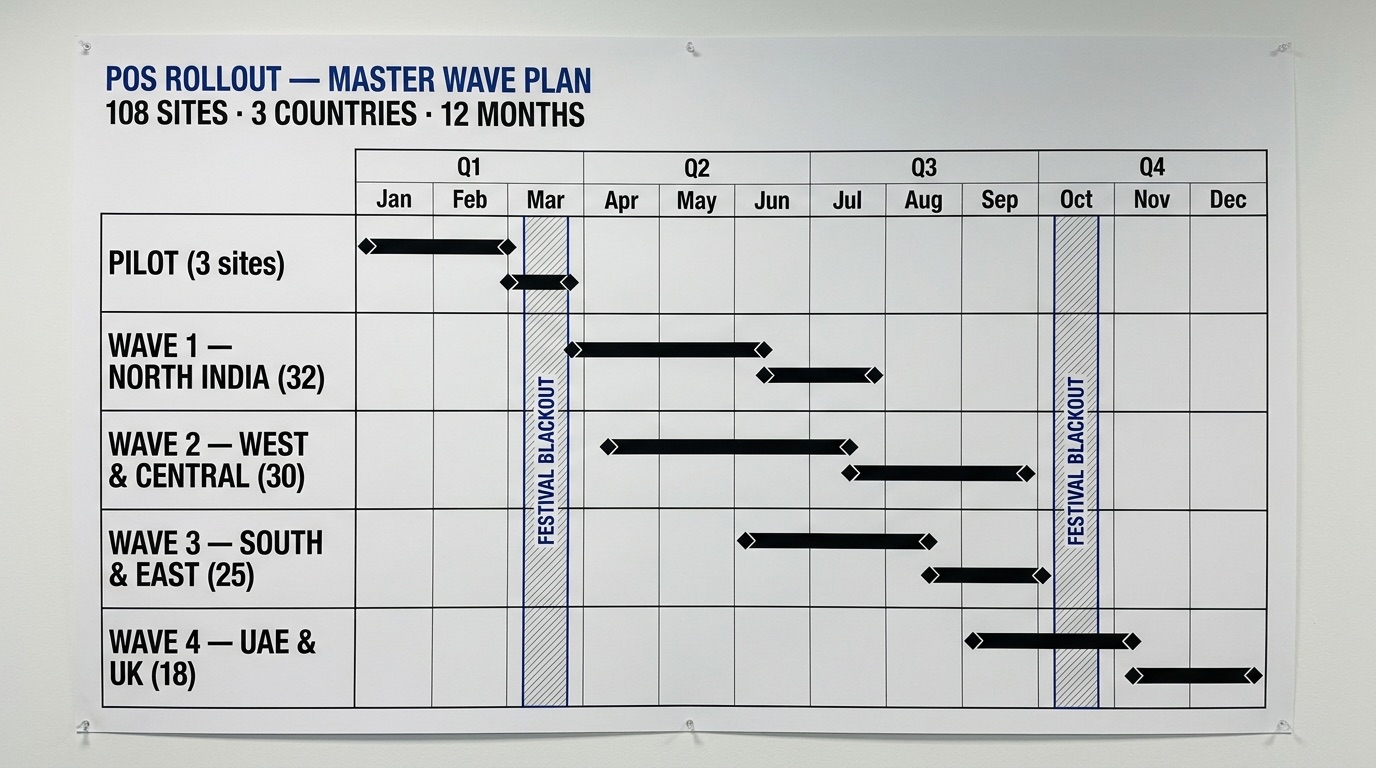
| Wave | Scope | Sites | Why sequenced here |
|---|---|---|---|
| Pilot | Delhi-NCR, company-owned | 3 | Harden the runbook and hybrid config; rebuild trust after the failed first attempt |
| Wave 1 | North India metros | ~32 | Densest cluster, company-owned, best support coverage |
| Wave 2 | West & Central India | ~30 | Scale the machine; first mixed owned + franchise wave |
| Wave 3 | South & East India | ~25 | The longest tail, franchise-heavy |
| Wave 4 | UAE, then UK | ~18 | International last, once the playbook was proven |
| Stage | What happened | Exit gate |
|---|---|---|
| Design & blueprint | Current-state mapping across dine-in, counter, online and delivery; one Guest/Food/Money system of record; menu, SKU, recipe and combo rationalization; per-category tax mapping; integration design across SAP, payments, aggregators, KDS and e-invoicing | Design sign-off |
| Build & configure | One golden standard config, with market localization layers for tax, language and receipt formats | Config baseline frozen |
| Data migration | Menu, pricing, recipe and loyalty data extracted from legacy tills, cleansed, loaded, reconciled per site | Migration reconciled |
| SIT | End-to-end POS to SAP to payments to aggregators to KDS, payment and UPI certification, e-invoice validation, festival peak-load test | SIT pass |
| UAT | 40+ scripted scenarios run by store operations and finance; defects logged, triaged and retested to closure | UAT signed off |
| Cutover | Per-site readiness checklist, dress rehearsal, overnight runbook, rollback plan on standby | Go-live sign-off |
| Hypercare | Role-based training, train-the-trainer for franchise, war-room triage with a first-day defect SLA | Stabilized & handed off |
| Metric | Before | After | How measured |
|---|---|---|---|
| Full rollout | 18-month internal plan | 12 months, 4 waves | PMO wave tracker |
| First-time-right cutovers | 1 failed pilot | 96% (104 of 108) | Cutover sign-off log |
| Per-site cutover window | ~2 days in pilot | ~4 hours, overnight | Install crew logs |
| Lost trading days | 1, at the failed pilot | 0 across 108 cutovers | Trading and cutover logs |
| Defects at go-live | — | 1.4 per site average, all closed within 48h | Defect log |
| Cross-region reporting | ~9 days, hand-assembled | Next morning (T+1) | BI refresh logs, 60 days post-wave |
“Our first switch to the new POS was not a success. Our staff struggled to program-manage it and it ran well over time. We decided to bring in an outside PMO and saw the results. This time every outlet came up overnight and opened clean, on a schedule we could actually see. Our franchise partners noticed the difference.”
Anonymized case study. Client-identifying details redacted. Reference available on request.