
Two missed
go-lives.
No third.
A $300M specialty manufacturer was 14 months into a 12-month Dynamics 365 program. Budget 60% over. Internal PM resigned. The board's question had shifted from “when does it go live” to “should we write this off.” We audited it in two weeks, told them the one thing nobody wanted to hear, and took it to go-live five months later.
$300M specialty manufacturer. 14 months into a 12-month implementation, two missed go-lives.
Microsoft Dynamics 365 F&O, with the original systems integrator kept on the build.
Two-week independent audit, then program takeover: re-baseline, SI renegotiation, UAT rebuild, cutover.
Audit to leadership in 2 weeks. Live 5 months after takeover.
Both sides were blaming each other. Both were partly right.
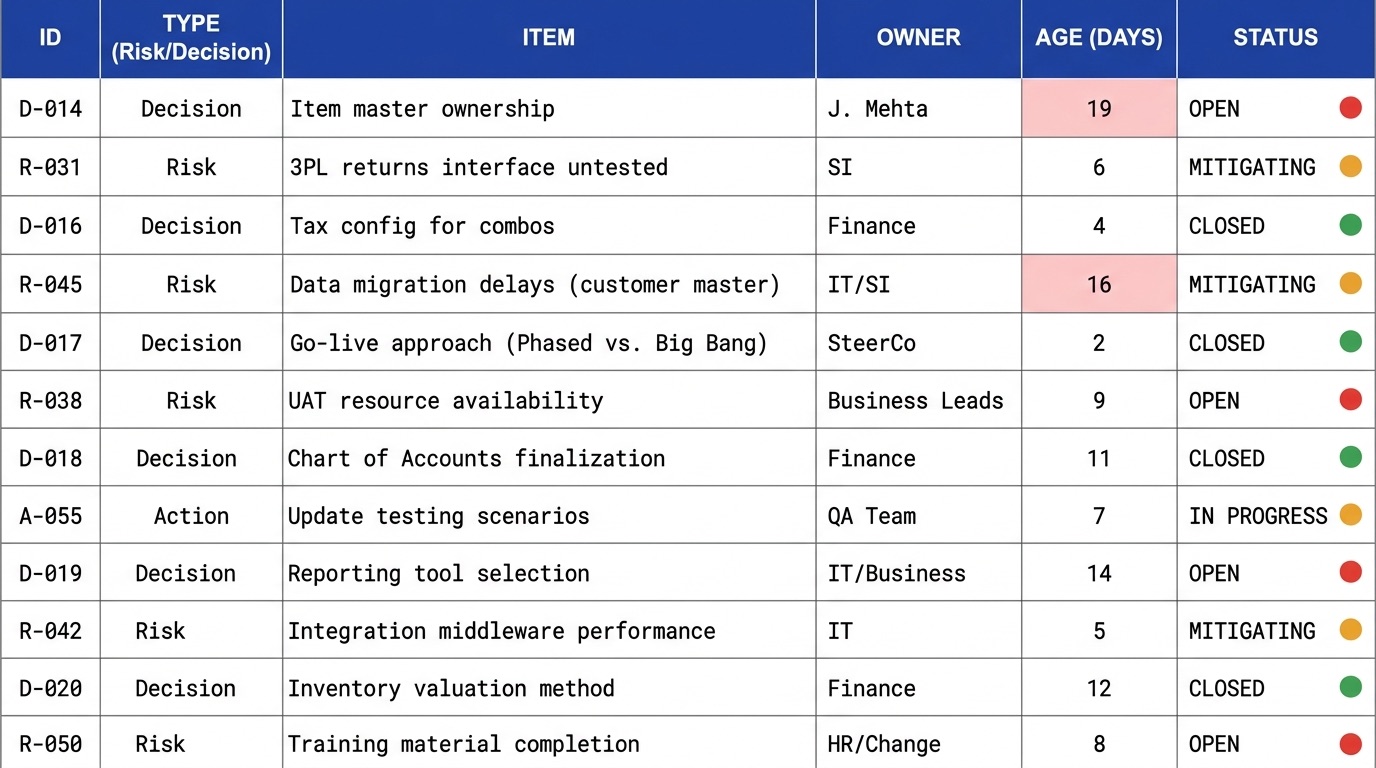
Fourteen months into a twelve-month program. Go-live missed twice. Budget 60% over and climbing, because waiting is billable too. The internal PM had resigned. The integrator blamed the client's data; the client blamed the integrator. Both were partly right, which is exactly why it could not be fixed from inside.
The industry math on a full write-off is brutal: recovering a failed ERP averages 150 to 200% of the original budget (Rand Group). The window to avoid that math was closing.
The two-week audit interviewed everyone, client team, department heads and the integrator, and read all 38 open change orders. Four findings carried the program's weight: nobody owned decisions, so the integrator kept building against assumptions. Several change orders covered work arguably in the original scope. UAT had never been resourced beyond “business users will test.” And the data problem was real but bounded: a six-week problem being treated as the excuse for six months of drift.
- Delivered the audit as written. Including the finding nobody wanted: go-live had to move eight weeks further out than anyone hoped. That recommendation, made in week two by someone with no history to defend, is what saved the program.
- Re-baselined honestly. One plan, dated, with named owners on every open decision.
- Renegotiated from the audit's findings. $240K of the 38 disputed change orders withdrawn or credited. The rest tied to phase gates going forward. Framed on evidence, not blame, because the same integrator has to maintain the system after go-live.
- Bounded the data problem. A six-week sprint with daily reconciliation. After that, no longer available as an excuse.
- Rebuilt UAT as a real workstream. Scenarios from production orders, a defect triage board, a daily 15-minute standup through test cycles.
- Ran cutover like a rescue should. Full rehearsal, rollback plan, war room staffed through the first two weeks of production.
| Stage | What happened | Exit gate |
|---|---|---|
| Independent audit, 2 wks | All-party interviews, change-order review, plan-versus-reality analysis | Findings to leadership |
| Re-baseline | Honest plan, decision log, named owners, the 8-week extension | Board sign-off |
| SI reset | Change-order renegotiation, phase-gated payments, weekly deliverable QA | Amended commercial terms |
| Data sprint | The six-week data fix, run as a sprint with daily reconciliation | Migration reconciled |
| UAT rebuild | Production-order scenarios, triage board, daily standup | UAT signed off |
| Cutover & hypercare | Rehearsal, rollback plan, 2-week war room | Stabilized & handed off |
| Metric | At takeover | At close | How measured |
|---|---|---|---|
| Audit turnaround | — | 2 weeks, all parties interviewed | Engagement record |
| Disputed change orders | 38 open | $240K withdrawn or credited; remainder phase-gated | Amended SI commercial terms |
| Missed go-lives | 2 | No third; live 5 months after takeover | Program record |
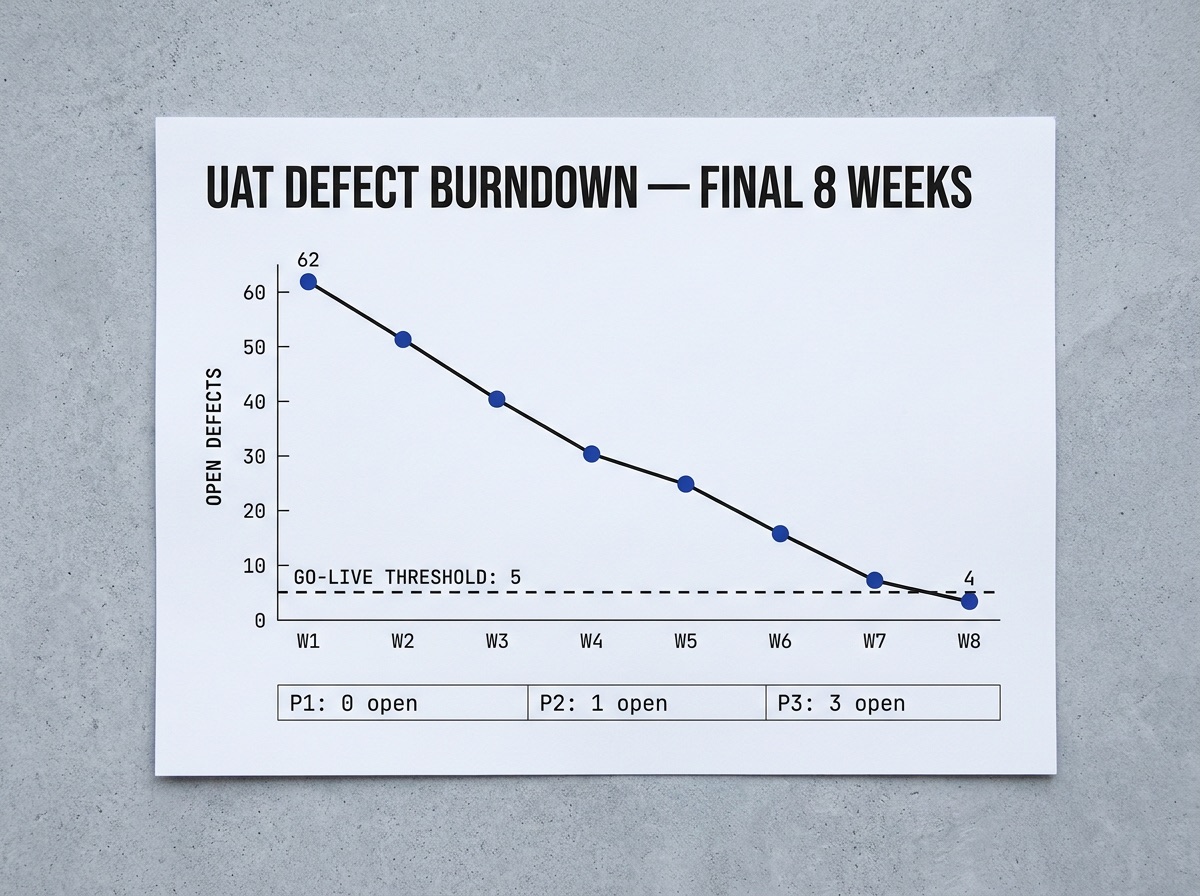
| Open defects | 62 | 4, none blocking | Defect log, final 8 weeks |
| Production days lost at cutover | — | 0 | Production and cutover logs |
The result that matters most is the one that does not fit a table: the integrator relationship survived. The renegotiation ran on findings, not grievances, and the same partner maintains the system today. Replacing an SI mid-program costs six months. Nobody paid that price.
Anonymized case study. Client-identifying details redacted. Reference available on request.